
Table of Contents
- Personalized Tumbler Design vs Mass Produced: The Core Differences
- How Custom and Factory Tumblers Compare Side by Side
- Custom Sublimation Tumbler Benefits for Everyday Use
- What It Costs: Custom Orders vs Bulk Manufacturing
- How to Design Custom Tumblers That Hold Up Over Time
- Longevity, Wear and Tear, and Copyright Rules
- Personalized Tumbler Care Instructions for Long-Lasting Design
- Frequently Asked Questions
Last Updated: September 25, 2026
Personalized Tumbler Design vs Mass Produced: The Core Differences
The personalized tumbler design vs mass produced debate comes down to one question: do you want a product with a story or a product with a barcode? At Lynne's Creations, we've handled enough custom orders to know the gap isn't just aesthetic. It's structural, financial, and emotional. A personalized tumbler is a drinkware item decorated with a name, message, or artwork chosen for a specific person or occasion.
What Counts as Mass Produced Drinkware
Mass produced drinkware comes off automated assembly lines in fixed designs, usually with no option to change the artwork, name, or color. Think of the rows of identical stainless steel tumblers at a warehouse store. The economics only work at volume, so factories run large batches and distribute them through retail chains. The trade-off is price. The limitation is sameness.

What Makes a Personalized Tumbler Different
A personalized tumbler starts with a person, not a product plan. The design phase comes first: artwork, names, colors, and messages get chosen or created before production begins. Small-batch production methods make this possible without tooling up a full factory line. That's why a custom order can carry a wedding date, a nickname, or a hobby reference that no retail shelf would ever stock.
How Custom and Factory Tumblers Compare Side by Side
The clearest way to see the difference is a direct comparison across the factors buyers actually care about.
| Factor | Personalized Tumbler | Mass Produced Tumbler |
|---|---|---|
| Design | Custom artwork, names, messages | Fixed, identical across units |
| Production method | Custom artwork application | Injection molding, bulk printing |
| Order size | One piece to small batches | Thousands per run |
| Unit cost | Higher per piece | Lower per piece |
| Lead time | Days to a few weeks | Immediate shelf availability |
| Uniqueness | One of a kind | One of thousands |
| Best for | Gifts, events, branding | Everyday replacement drinkware |
Custom Sublimation Tumbler Benefits for Everyday Use
Custom tumbler benefits go beyond looks. The design is bonded into the coating of a vacuum-insulated stainless steel tumbler rather than sitting on top of it. That matters for daily use.

- The design won't peel or flake the way cheap stickers do
- Double-wall vacuum insulation keeps drinks hot or cold for hours
- Full-wrap designs cover the entire tumbler, not just a patch
- Slim profiles fit most standard cup holders
What It Costs: Custom Orders vs Bulk Manufacturing
Custom orders cost more per piece, and that's not a flaw. It's the price of a design that exists for one person. But the gap between a $20.00 personalized tumbler and a $9.00 warehouse tumbler isn't arbitrary, it maps to specific cost drivers, and understanding them tells you exactly when each path makes financial sense.
Where the Extra Money Goes on a Custom Order
A factory amortizes setup across thousands of units. A small studio amortizes it across one. That single sentence explains most of the price gap, but the line items behind it are worth naming:
- Design and proofing labor. Someone has to build the artwork, set the type, and send you a proof. On a 500-unit factory run, that labor spreads across every unit. On a single custom tumbler, it lands entirely on yours.
- Small-batch production setup. Sublimation requires a heat press, a wrap, and a cured powder coating. Laser engraving requires a jig and a calibrated laser. Each setup takes time that a factory line eliminates through volume.
- Per-unit quality control. A factory spot-checks a run. A small studio inspects the one tumbler it just made, because there's no statistical sample to hide behind.
- Material and blank cost. Small studios buy blanks in low volumes, so they pay closer to retail on the stainless steel body, lid, and straw. Factories buy by the container.
When Bulk Pricing Actually Saves You Money
Bulk manufacturing wins when the item is disposable or impersonal. Buying 50 identical tumblers for a corporate giveaway makes sense if nobody needs to feel singled out. Bulk pricing also wins on replacement drinkware you don't care about losing.
The Cost Nobody Puts on the Invoice
Most cost comparisons stop at the register. The environmental ledger looks different. Mass produced drinkware depends on long distribution chains, factory to port, port to warehouse, warehouse to big-box shelf, and on the disposable economics that encourage replacement when a design feels dated. Small-batch custom production skips most of that chain and, more importantly, produces an item the owner is far less likely to replace.
How to Design Custom Tumblers That Hold Up Over Time
Design decisions made in five minutes determine whether your tumbler looks great in year three or faded by month six.
I'm Not Perfect But I'm Limited Edition →
Design Resolution and Print Method Matter
Match the method to the design:
If you don't have a design ready, that's fine. We can help shape a concept into something printable. You don't need to be an artist to order something beautiful.
Longevity, Wear and Tear, and Copyright Rules
Durability and legality are the two things most buying guides skip. Both matter more than most people expect. And on durability, most guides offer nothing but vibes, "sublimation lasts longer", without saying longer than what, under what conditions, or how you'd verify it. Here's a structured way to think about it.
How the Major Finishes Actually Wear
Every decoration method fails in a different way. Knowing the failure mode tells you what to watch for.
- Sublimation into powder coating. The dye bonds into the coating itself, so the design has no edge to lift. Failure mode is gradual fade from UV exposure and repeated high-heat washing, not peeling. Most practitioners find a properly cured sublimated tumbler holds its color for years with hand washing.
- UV printing. Cured ink sits on the surface. It resists scratching better than vinyl but can chip at high-wear points like the rim and base if the tumbler is dropped or knocked around in a bag.
- Laser engraving. Removes coating to expose bare stainless steel. The mark is permanent and cannot fade, but it's single-color by nature and the engraved area can trap residue if not cleaned.
- Vinyl decals. The most common failure mode in custom drinkware. Adhesive lifts at the edges, especially after dishwasher cycles, and the design peels away in sheets.
- Factory powder coating (no design). Extremely durable on its own, but offers no customization, the finish is the product.
A Wear-and-Tear Test You Can Run Yourself
No published lab data exists comparing custom prints to factory finishes over a multi-year span, which is exactly why a simple home test beats marketing claims. Before committing to a large order:
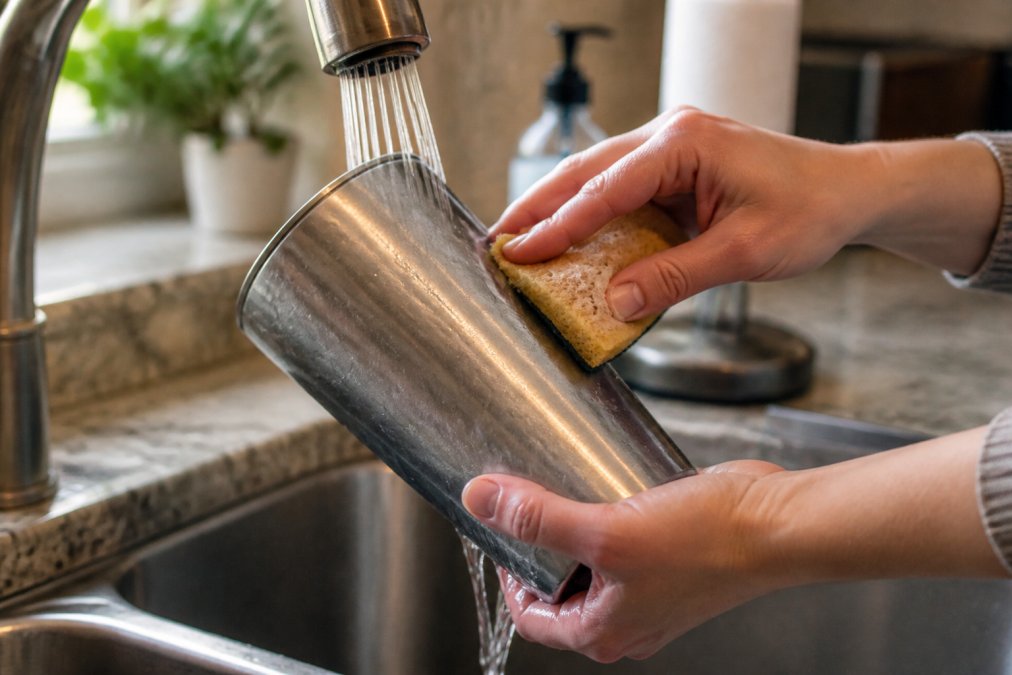
- Wash test. Hand wash one tumbler daily for two weeks with mild soap and a soft sponge. Check the design edges under bright light for fading or lifting.
- Abrasion test. Rub a small, inconspicuous area with a soft cloth and a dab of baking soda paste. A properly cured sublimated finish won't budge; a poorly cured one will dull immediately.
- Heat test. Fill with hot water and let it sit for an hour. Watch for any clouding or color shift in the design.
- Drop test. From counter height onto a hard floor, check whether the coating chips at the impact point. This is where UV-printed designs separate from sublimated ones.
Legal and Copyright Considerations for Custom Artwork
You cannot legally print a sports team logo, a cartoon character, or a brand mark onto a tumbler without permission from the rights holder. Copyright and trademark law apply to personal gifts too, not just commercial resale. The U.S. Copyright Office guide to fair use explains the limited exceptions. The safest path is original artwork, licensed designs, or text and names you own.
Personalized Tumbler Care Instructions for Long-Lasting Design
Personalized tumbler care instructions are simple, but skipping them shortens the design's life fast. Hand wash with warm water, mild soap, and a soft sponge. Avoid abrasive scrubbers, which dull the finish even on durable coatings. Skip the dishwasher entirely, since high heat and harsh detergent break down the design over time. Don't soak the tumbler for long periods, and dry it with a soft cloth rather than letting it air dry with water spots.
Frequently Asked Questions
What are the main quality differences between custom and mass-produced tumblers?
Mass-produced tumblers come off a high-volume line with the same artwork on every unit. A personalized tumbler is decorated in small batches, so each piece gets individual attention during printing or engraving. Both can start with vacuum-insulated stainless steel, but the finish is where they diverge: custom work usually uses methods that hold color better across the full wrap. Factory pieces often use simpler decals or pad printing that can look flatter.
Is it worth paying more for a personalized tumbler design?
It depends on the occasion. For a wedding party, anniversary, or housewarming, a custom piece carries meaning a generic tumbler cannot. At Lynne's Creations, personalized stainless steel tumblers start at $20.00, which keeps the upgrade modest compared to many gift options. If you need 50 identical promotional cups at the lowest possible unit cost, bulk manufacturing wins. For 8 to 10 gifts where each person matters, the custom route usually pays off in how the gift lands.
How long does a custom tumbler take to arrive?
Lead time depends on the design and order size, not the tumbler itself. A single personalized piece with a ready template moves faster than a fully custom design that needs proofs and revisions. Small-batch production also adds a step that mass manufacturing skips. If you have a deadline like a wedding in six weeks, order early and confirm the timeline before you commit, since rush options are not always available on handcrafted work.
Will the design fade or chip after a few months of regular use?
A properly applied design on stainless steel holds up well when you follow the maker's care rules. Most fading comes from heat and abrasion, which is why hand washing matters. Dishwasher cycles expose the finish to high heat and harsh detergent, and that is the fastest way to dull a full-wrap design. Hand wash with mild soap, skip abrasive sponges, and the artwork should stay vivid far longer than a printed decal on a cheap cup.