
Table of Contents
- How We Evaluated the Quality of Custom Printed Kitchen Items
- What to Look For in Food-Safe Printing Methods for Kitchenware
- Longevity of Sublimation vs Screen Printing on Kitchen Items
- Dishwasher Safe Custom Kitchen Items: What Actually Survives
- Reviewing Glass Cutting Boards from Lynne's Creations
- Custom Printed Mugs and Drinkware: A Closer Look
- Small-Batch vs Bulk Customization: Which Fits Your Order
- Verdict: Who Should Buy Custom Printed Kitchen Items
- Frequently Asked Questions
Last Updated: September 13, 2026
How We Evaluated the Quality of Custom Printed Kitchen Items
Custom printed kitchen items are kitchenware, cutting boards, mugs, utensils, decorated with permanent designs through heat-based printing. This review examines what separates a print that lasts years from one that fades in months.
Most shoppers judge these products by the preview image. That's the wrong test: the design on screen says nothing about whether the ink survives a dishwasher cycle or whether the surface is safe to eat off.
The Five-Point Quality Checklist We Used
Every piece was scored against five criteria. A product can look beautiful and still fail three.
- Print method: sublimation, screen printing, or a decal that peels
- Substrate quality: tempered glass, food-grade ceramic, or untreated plastic
- Food-contact safety: does the print sit under a protective surface or directly on the eating area
- Wash durability: hand-wash only, or genuinely dishwasher safe
- Design permanence: does the image sit inside the material or on top of it
Point five is the one most buyers miss. Sublimation infuses the design into a coated surface at high heat, so there's no raised layer to chip. Screen printing lays ink on top, which is why cheap printed mugs flake around the rim.
What to Look For in Food-Safe Printing Methods for Kitchenware
Food-safe printing methods for kitchenware keep decoration away from the food-contact surface, or use inks and coatings rated for food contact. The safest designs place the print on the exterior or underside, leaving a clean cutting or drinking surface.
The practical rule: a decorated mug should carry its design on the outside wall, never inside the vessel or across the lip. A cutting board should be used print-side-down or reserved for serving, since any printed glass surface scratches under a knife.
The Regulatory Framework Most Buyers Never Hear About
In the United States, materials intended to contact food fall under FDA oversight of food-contact substances (the FDA). The FDA guidance on food-contact substances explains that manufacturers are responsible for ensuring their materials are safe for their intended use. For a buyer, this translates to one question: is the decorated surface meant to touch food, or is it decorative?
The deeper layer is 21 CFR Part 177, the FDA's Indirect Food Additives: Polymers regulation, which governs the resins, coatings, and inks that may legally contact food and limits how much of a substance can migrate into food under normal use (ecfr.gov). A sublimation coating on a mug exterior is not a food-contact substance because it never touches the beverage; the same coating inside the mug would need to comply with Part 177 or hold a Food Contact Notification.
Reputable sellers often use coatings and inks already on the FDA's list of permitted indirect food additives, even when the print is decorative, a conservative choice that keeps the item safe even if a buyer uses it in a way the seller didn't intend.
Migration, Leaching, and the Tests That Matter
Migration is behind most food-safety concerns with printed kitchenware. When a coating, ink, or adhesive contacts food, especially hot, acidic, or fatty food, small amounts of its chemical components transfer into the food. The FDA evaluates this through migration testing, which simulates real use conditions and measures how much of a substance ends up in the food simulant.
You won't see migration data on a product page. What to look for instead:
- A stated food-contact rating. Phrases like "FDA-compliant food-contact coating" or "food-grade sublimation coating" signal the seller has done the homework.
- BPA-free and phthalate-free claims. These matter most for plastic substrates and any coating that could contact food. They are not a substitute for full food-contact compliance, but they rule out two common problem chemicals.
- Prop 65 warnings. California's Proposition 65 requires warnings for products that expose users to listed chemicals above safe-harbor levels. A Prop 65 warning is not automatically disqualifying, but it is a signal to ask the seller what triggered it.
- A clean interior. On mugs, cups, and tumblers, the inside surface should be bare glass, bare ceramic, or bare food-grade stainless steel. Any coating inside the vessel is a red flag.
Heat, Acid, and Fat: The Three Stressors That Accelerate Migration
FDA migration testing stresses materials with the conditions that pull chemicals out fastest:
- Heat softens polymer coatings and increases the rate at which additives move into food. A mug that is safe with cold water may behave differently with near-boiling coffee.
- Acid (tomato sauce, citrus, vinegar, wine) attacks many coatings and can accelerate leaching of metals and plasticizers.
- Fat (oils, butter, creamy sauces) is the most aggressive of the three because many chemical additives are fat-soluble and migrate readily into oily foods.
That's why a board used for raw chicken or a hot roast carries a different risk profile than one used to serve crackers, and why the safest custom kitchen items keep the print on a surface that never sees food at all.
What to Ask Before You Buy
A short list of questions separates a seller who understands food safety from one repeating marketing copy:
- Is the printed surface intended for food contact, or is it decorative?
- What substrate is under the print, tempered glass, food-grade ceramic, food-grade stainless steel, or untreated plastic?
- Does the seller state a food-contact rating, BPA-free status, or Prop 65 status?
- Are wash instructions specific, or generic?
- If the item is a mug or tumbler, is the interior bare?
If a seller answers those five questions clearly, the item is likely built to a standard worth paying for. If the answers are vague, the design may still be pretty, but you're taking on risk the seller should have retired.
Longevity of Sublimation vs Screen Printing on Kitchen Items
Sublimation outlasts screen printing on kitchen items that see heat and repeated washing. Because it bonds the design into a polymer coating rather than laying ink on top, there's no film to lift and the print resists fading far better than surface-printed alternatives.
Screen printing still has its place: it's cost-effective for flat textiles like aprons and oven mitts, where ink sits on woven fabric rather than a hard surface. On glass and ceramic, screen-printed designs are the ones that eventually crack and peel.
Why Sublimation Lasts: The Mechanism
Sublimation works because certain dyes convert directly from solid to gas at around 350-400°F without a liquid phase. When that gas meets a polyester or polymer-coated surface, it penetrates and re-solidifies inside. The result isn't a layer on top, it's the item, dyed from within.
That mechanism explains the durability: no adhesive to fail, no ink film to chip, no edge for a fingernail or dishwasher jet to catch. The design can only fade if the polymer itself degrades, which is why substrate quality matters as much as print method.
Screen printing, by contrast, deposits a layer of ink and cures it. On fabric, the ink locks into the weave and survives dozens of washes. On glass or glazed ceramic, it sits on a non-porous surface with nothing to grip; add heat and detergent and the bond weakens from the edges inward.
How the Major Print Methods Compare Under Real Kitchen Conditions
| Method | How It Bonds | Best Surface | Dishwasher Cycles (Typical) | Fade Risk | Food-Contact Safe? |
|---|---|---|---|---|---|
| Sublimation | Infused into polymer coating | Coated glass, coated ceramic, polyester | 100+ on quality substrates | Low | Yes, if coating is food-grade |
| Screen printing | Cured ink layer on top | Fabric, flat textiles | 20-50 on fabric; far fewer on glass | Moderate to high on hard surfaces | Yes on fabric; varies on hard surfaces |
| UV printing | UV-cured ink on top | Glass, ceramic, metal, plastic | 30-75 depending on ink and topcoat | Moderate | Yes if ink is food-grade and cured fully |
| Vinyl decal | Adhesive film | Any smooth surface | 5-20 | High | No on food-contact surfaces |
| Laser engraving | Etched into substrate | Wood, bamboo, some coated metals | Effectively permanent | None | Yes, no added chemistry |
Those numbers are typical ranges, not guarantees. A sublimated mug from a seller who tested their coating will outlast a UV-printed mug from one who didn't, even though UV printing can be durable when done well.
The Dishwasher Is the Real Test
Hand washing is gentle; a dishwasher is not. Three things shorten the life of any printed surface inside a residential dishwasher:
- Heat. The drying cycle on many models reaches 140-160°F, and some sanitize cycles go higher. That's enough to soften some decorative coatings and accelerate dye migration out of a sublimated surface.
- Detergent. Modern dishwasher detergents are alkaline and contain enzymes and abrasives designed to strip baked-on food. They do not distinguish between food residue and a printed design.
- Mechanical action. Spray jets hit items at pressure, and items knock against each other. On a screen-printed or vinyl-decorated surface, that's how edges start to lift.
Sublimated designs on quality coated glass or ceramic handle all three well. Screen-printed designs on glass handle the first two poorly and the third worse. Vinyl decals fail fastest, most buyers see peeling within months of regular machine washing.
How to Predict Longevity Before You Buy
You can't run a dishwasher test on a product page, but you can read the signals:
- "Dishwasher safe" stated prominently. Sellers who tested their items say so, because it's a selling point. Sellers who didn't stay quiet.
- "Top-rack dishwasher safe" specifically. Top-rack means lower heat and gentler spray. It's an honest middle ground and a sign the seller knows their product.
- "Hand wash recommended." This is not a defect. It's often the trade-off for a matte or frosted finish that would dull in a machine. Respect it and the item lasts years.
- No wash instruction at all. Assume hand wash only, and assume the seller never tested.
- Substrate named. "Tempered glass" or "food-grade ceramic" tells you the print has something durable to bond to. "Glass" alone tells you nothing.
The Trade-Off Nobody Mentions
The most durable print isn't always the best choice. Laser engraving is effectively permanent and adds no chemistry, but only works on wood, bamboo, and some coated metals, it can't reproduce full-color designs. Sublimation gives full color and high durability, but only on polymer-coated surfaces. Screen printing is the most versatile for fabric and the least durable on glass.
The right question isn't "which method is best" but "which method matches the substrate and the use." A hand-wash-only sublimated frosted glass mug will outlast a screen-printed glass mug that claims to be dishwasher safe, because the sublimated design has nothing to peel. Match the method to the material, follow the wash instructions, and the print outlasts the novelty of the design.
Dishwasher Safe Custom Kitchen Items: What Actually Survives
Dishwasher safe custom kitchen items are those where both substrate and print are rated for machine washing. Tempered glass drinkware with a sublimated wrap typically qualifies; frosted glass mugs with delicate finishes often do not.
Heat is the real enemy: a dishwasher's drying cycle softens some decorative coatings, and harsh detergent accelerates the breakdown. That's why some of our own mugs are labeled hand wash only, the frosted finish and the design both last longer that way.
Heat, Detergent, and the Real Cost of a Faded Design
A faded design isn't just an aesthetic problem. When a print degrades on a food-contact surface, you're left with a partially worn coating exactly where you cut or drink. Hand washing with warm water and mild soap is the easiest way to extend the life of any printed kitchen item, and it costs nothing.
Reviewing Glass Cutting Boards from Lynne's Creations
Our tempered glass cutting boards show how print method and substrate work together: each starts with a tempered glass panel, then receives a full-color sublimated design that fuses into the surface rather than sitting on it.
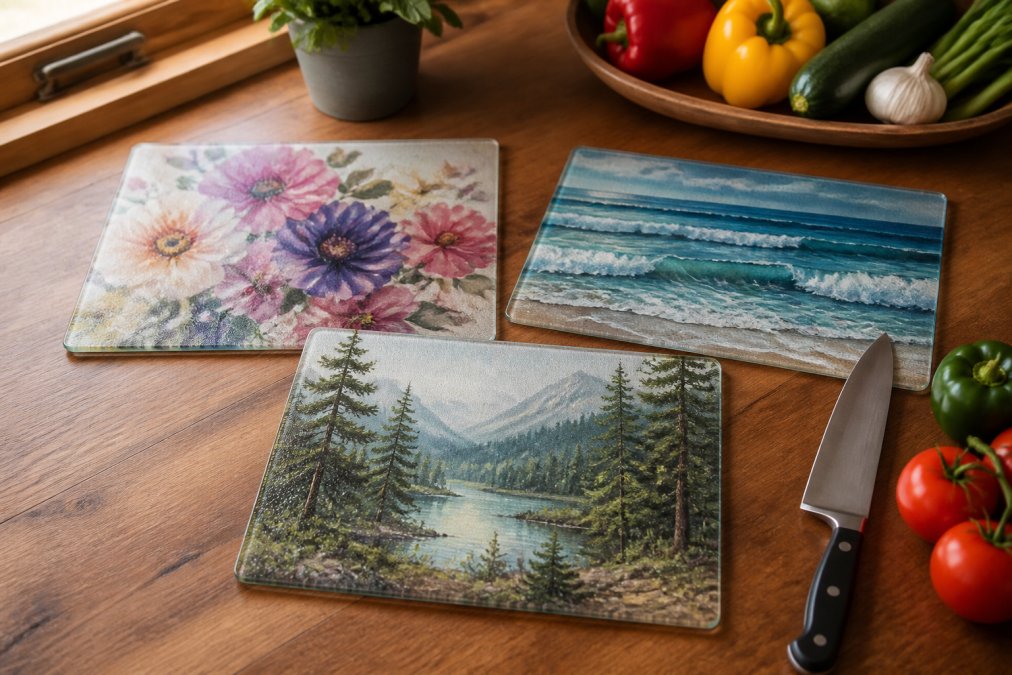
The "She's Got A Knife!!!" Glass Cutting Board(https://lynnescreations.com/products/shes-got-a-knife-glass-cutting-board) is a good test case. Three panicked chickens, a bold warning, and a design that reads clearly at 11 by 7.87 inches. It's funny, but the construction is what matters: tempered glass, a permanent print, and a surface that wipes clean. The "Kitchen Crimes In Progress" Glass Cutting Board(https://lynnescreations.com/products/kitchen-crimes-in-progress-glass-cutting-board) uses the same build with a different sense of humor, and the Farmhouse Rooster Glass Cutting Board(https://lynnescreations.com/products/farmhouse-rooster-glass-cutting-board-11x7-87) proves the format works for decor as well as comedy.


One honest limitation: these are hand wash recommended. Treat them as serving pieces and display boards, and they'll look new for years.
Custom Printed Mugs and Drinkware: A Closer Look
Drinkware is where buyers get burned most often, because the design sits inches from your mouth. Our frosted glass mugs put the print on the exterior wall only, keeping the drinking surface clean glass.
The Rustic Farmhouse 17oz Frosted Glass Mug(https://lynnescreations.com/products/rustic-farmhouse-17oz-frosted-glass-mug-with-handle) is dishwasher safe, which is unusual for a decorated mug. The Halloween Pumpkin Burst 17oz Glass Handled Mug(https://lynnescreations.com/products/halloween-pumpkin-burst-17oz-glass-handled-mug-with-bamboo-lid-straw) also holds up to machine washing and adds a bamboo lid and straw. The Cozy Season 17oz Frosted Glass Mug(https://lynnescreations.com/products/cozy-season-17oz-frosted-glass-mug) takes the opposite approach: its soft matte finish is hand wash only, and that's the tradeoff for the texture.
Small-Batch vs Bulk Customization: Which Fits Your Order
Small-batch customization suits gift orders of a handful of pieces, where each item carries a different design.
For a wedding party of eight to ten, individual names or motifs are possible.
| Your Situation | Best Approach | Why |
|---|---|---|
| Wedding party, 8-10 gifts | Small-batch | Individual designs, no bulk minimum |
| Corporate event, 100+ units | Bulk | Lower per-unit cost |
| Single gift | Small-batch | One-off design, no commitment |
Verdict: Who Should Buy Custom Printed Kitchen Items
Buy custom printed kitchen items when the design is permanent, the surface is food-safe, and the seller tells you exactly how to wash it. Skip anything where the print sits on the food-contact side, wash instructions are missing, or the design looks like a sticker.
Lynne's Creations builds every piece around those three rules: tempered and frosted glass substrates, sublimated designs that fuse into the surface, and clear wash guidance on each product page. For a gift that needs to feel personal and last, that combination is what you're paying for.
Choosing a personalized gift means trusting the piece will still look right months later, after the wedding photos are filed away and the mug has been through a hundred mornings. That trust comes from construction, not a pretty preview. Lynne's Creations offers handcrafted tumblers and glass cutting boards with sublimated designs, custom order options for individual pieces, and gift-ready forms built for occasions that matter. Continue shopping with Lynne's Creations and find something made just for the person you have in mind.
Frequently Asked Questions
How do you tell if custom printed kitchenware is food-safe?
Check that the printed surface sits on a food-contact-safe base material and that the ink is cured into it rather than sitting on top. Tempered glass with a sublimated design is a good example: the print is fused into the glass, leaving a smooth, non-porous surface with nothing to flake into food. Avoid any printed item where the design feels raised, tacky, or peels at the edges, and ask the seller directly which printing method was used.
Do custom printed kitchen items fade in the dishwasher?
It depends on the printing method and the base material. Sublimated designs on dishwasher-safe glass mugs typically hold up well through normal cycles, while hand wash only pieces like some frosted mugs will lose their finish faster in hot water and harsh detergent. Detergent is often harder on prints than heat alone. When a listing says hand wash, treat that as the real limit of the product, not a suggestion.
How long does sublimation printing last compared to screen printing?
Sublimation fuses dye into a coated surface, so on glass and coated drinkware it resists fading, cracking, and peeling for years of regular use. Screen printing lays a layer of ink on top of the material, which can look bolder at first but is more prone to scratching and chipping at the edges over time. For kitchen items that see repeated washing, sublimation usually wins on longevity.
Are custom printed cutting boards durable enough for daily use?
Tempered glass cutting boards handle daily chopping and serving without warping, staining, or absorbing odors the way wood can. The trade-off is that glass dulls knives faster, so many people use them as serving boards or reserve a separate surface for heavy knife work. The printed design itself, when sublimated into tempered glass, will not peel or scratch off with normal use. Hand washing keeps the surface looking new longest.
What does a custom printed kitchen item cost, and is it worth it?
At Lynne's Creations, glass cutting boards run $15.00 and 17 oz. frosted glass mugs run $10.00, both one-time purchases. That price buys a tempered glass base, a permanent sublimated design that will not peel, and a piece that works as both a usable tool and a gift. Compared with mass-produced printed items that fade within months, the cost per year of use is usually lower, not higher.