
Table of Contents
- Vivoprint vs Cameo Glass in 2026: Print Methods at a Glance
- Personalized Gift Quality Comparison: Durability and Color Accuracy
- Pricing Breakdown: Cost Per Piece and Bulk Ordering
- How to Choose a Personalized Gift Provider
- Best Custom Glassware Platforms 2026: UX and Sustainability
- Where Each Platform Wins: Use Cases and Final Verdict
- Frequently Asked Questions
Last Updated: September 28, 2026
Vivoprint vs Cameo Glass in 2026: Print Methods at a Glance
The vivoprint vs cameo glass question really comes down to two different production philosophies: fast, image-based printing versus slower, subtractive finishing. This guide from Lynne's Creations breaks down how each method affects what you actually receive in the mail, because the process a provider uses determines everything about how the finished piece looks and holds up.
| Method | How It Works | Best For | Main Trade-Off |
|---|---|---|---|
| Sublimation | Heat bonds ink into coating | Full-color wraps on tumblers | Needs polymer coating |
| Digital printing | Ink applied and cured | Photographic detail, flat surfaces | Print sits on surface |
| Engraving | Material carved away | Glassware, metal, permanence | Limited color range |
Sublimation and digital printing compared
Sublimation can achieve vibrant color saturation for curved drinkware. Because the ink turns to gas and penetrates the coating, full-wrap designs can appear seamless, with no visible edge where the print stops. Digital printing tends to show a slight raised texture and a faint seam on cylindrical items.
Engraving and finishing options
Engraving can produce a durable result, since there is no applied layer to fail. The catch is color: engraved designs read as frosted white or raw metal, so they suit monograms, line art, and simple typography better than detailed artwork. A durable finish, whether engraved or topcoated, is what separates a gift that lasts from one that disappoints.
Personalized Gift Quality Comparison: Durability and Color Accuracy
Durability and color accuracy are the two quality markers that matter most, and they pull in opposite directions. The most vivid print methods are usually the least scratch-resistant, while the most permanent methods limit your color range. Understanding why that trade-off exists is what separates a buyer who picks the right method from one who reorders in six months.
Why sublimation color holds, and why it fails
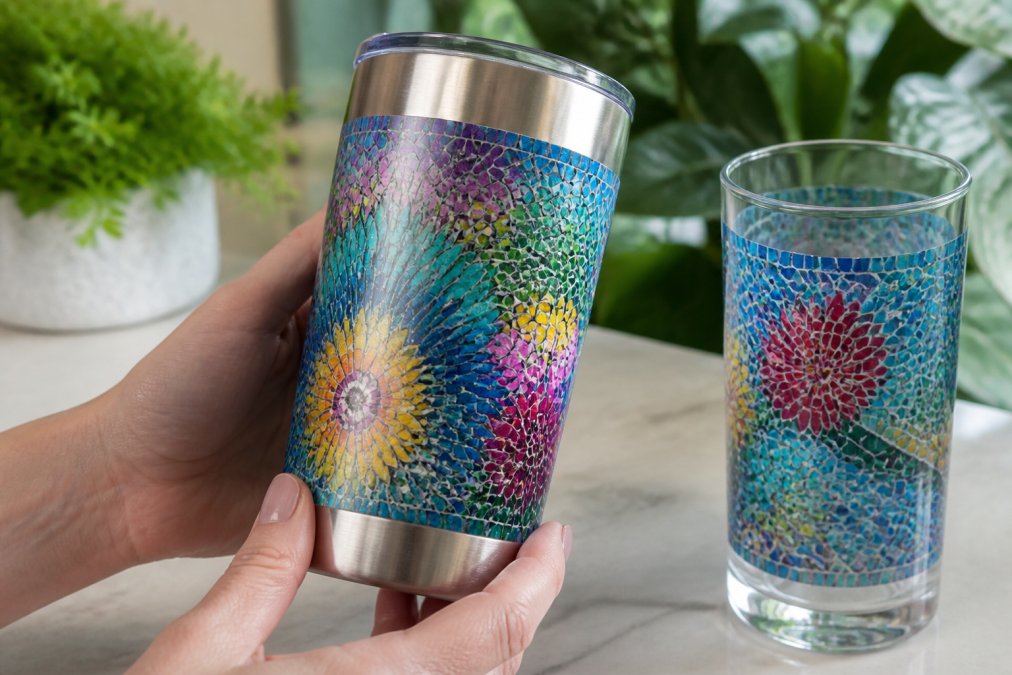
On a sublimated stainless steel tumbler, the print quality depends on the polymer coating and the heat calibration. During pressing, the ink turns to gas and diffuses into the coating, which is why a full-wrap stained-glass mosaic can show no visible edge where the design stops. When the dwell time, temperature, and pressure are right, the jewel tones sit locked inside the coating.
How each finish actually fails
Different finishes fail in different ways, and knowing the failure mode tells you how to care for the piece:
- Sublimated coating: the print cannot peel on its own, but the polymer layer can chip, cloud, or wear through at the rim and base where the tumbler contacts surfaces. Once the coating breaks, the print goes with it.
- Direct digital print: the ink layer sits closer to the surface, so it resists coating failure but is more vulnerable to abrasion and to solvents in dish detergent.
- Engraved glass or metal: there is no applied layer to fail. The mark is a physical change in the material, so it cannot fade, peel, or wash off, but it also cannot reproduce full color.
A practical durability test you can run at home
Before you commit a full order, run one piece through a normal week. Wash it by hand with dish soap, leave it in a hot car for an afternoon, and check the rim and base for clouding or edge wear. If a sublimated tumbler is going to fail early, it often shows at the rim first. Engraved pieces will pass this test unchanged, which is why monograms and line art are often well-suited for glass and metal rather than on a coated print surface.
Pricing Breakdown: Cost Per Piece and Bulk Ordering
Pricing for custom glassware and drinkware scales in two directions: per-piece cost drops as quantity rises, but setup and design fees can offset the savings on small runs. The real question is cost per finished piece, not sticker price.
- Per-piece base cost: the unit price for the item itself
- Design or setup fee: a one-time charge, often waived on larger runs
- Personalization surcharge: added when each piece differs
- Shipping logistics: weight and packaging drive this more than distance
| Item | Price | Best For |
|---|---|---|
| Storybook Bear Mosaic Tumbler | $20.00 | Nostalgic, whimsical gifts |
| Stained Glass Lily Tumbler | $20.00 | Floral, elegant gifting |
| Stained Glass Chimpanzee Mouse Pad | $9.99 | Desk and office gifts |
How to Choose a Personalized Gift Provider
Choosing a personalized gift provider comes down to five checks, and most buyers skip the two that matter most. Run every provider through this list before you order.
- Material composition: is the base stainless steel, glass, or a coated composite?
- Finishing method: sublimation, digital print, or engraving, and does it match your design?
- Turnaround time: confirm the production window in writing, not just shipping time
- Design template access: can you upload artwork, or do you start from a template?
- Resolution requirements: ask the minimum pixel density or vector graphics standard they accept
Best Custom Glassware Platforms 2026: UX and Sustainability
When considering custom glassware, two important factors are how easy the design upload actually is, and what happens to the piece at the end of its life. Both matter more than a slick homepage, and neither shows up in a product listing.
Storybook Bear Mosaic 20 oz Stainless →

The design upload workflow, step by step
On user experience, the friction point is almost always the design upload. A platform that accepts vector graphics and gives clear resolution guidance can save hours of back-and-forth. One that accepts anything and silently prints a blurry result can lead to a reorder. Here is a workflow to expect from a platform that has thought this through:
- File intake: the uploader accepts common raster formats (PNG, JPG) and vector formats (SVG, PDF, AI). Vector files scale without quality loss; raster files do not.
- Resolution check: the tool flags files below roughly 300 DPI at the intended print size. Below that threshold, edges soften and fine line art breaks up.
- Placement preview: a live mockup shows the design wrapped on the actual product, including how it distorts around a curved tumbler.
- Color soft-proof: the platform shows an approximate print-color preview rather than the raw RGB screen color, so you see the softer output before you order.
- Proof approval: you confirm a digital proof before production starts. Skipping this step is the single most common cause of reorders.
What eco-friendly production actually looks like
Sustainability is where small, independent makers tend to pull ahead of mass-produced retail, but the word gets used loosely. Here are some concrete practices to look for:
- Small-batch production: handcrafted runs are made to order, which means less overstock headed for landfill at the end of a season.
- Durable goods over disposable ones: a piece built to be kept for years replaces a series of cheap replacements, and that replacement cycle is where most of the environmental cost hides.
- Material choices: stainless steel and glass are widely recyclable at end of life, unlike mixed-material composites that are difficult to separate.
- Packaging: recyclable or minimal packaging reduces the shipping footprint that comes with every custom order.
Where Each Platform Wins: Use Cases and Final Verdict
Print-based platforms can be a good choice when speed and volume matter most. Engraving and artisan finishing can be ideal when the piece needs to last and feel personal. Matching the method to the occasion can help ensure you are rarely disappointed.
Frequently Asked Questions
Is Vivoprint better for custom glassware than Cameo Glass?
Neither platform is universally better; the right choice depends on your project. Vivoprint tends to suit high-volume, budget-conscious orders where speed matters. Cameo Glass focuses on artistic, handcrafted pieces with more detailed finishing. For a personalized gift where quality and longevity matter most, compare material composition, print method, and turnaround time before deciding. Lynne's Creations offers handcrafted stainless steel tumblers and custom orders starting at $20, which gives you a quality benchmark to compare against.
What are the primary differences between Vivoprint and Cameo Glass printing techniques?
Vivoprint typically uses digital printing and sublimation, which transfer designs onto curved surfaces quickly and affordably. Cameo Glass leans toward engraving and finishing options that cut or etch into the material itself. Sublimation can produce vivid, full-color imagery but may wear over time if not properly sealed. Engraving creates a permanent mark that will not fade, though it usually limits you to single-color designs. The technique you choose affects durability, color accuracy, and how the finished gift feels in hand.
Which platform is more cost-effective for bulk personalized gifts?
For bulk ordering, per-piece pricing drops as quantity rises on most platforms. Vivoprint generally offers lower entry pricing for large runs because digital printing scales efficiently. Cameo Glass may charge more per piece for engraving and hand-finishing, but the result is a more durable, tactile product. If you are ordering 8-10 pieces for a wedding party, ask each provider for a written quote that includes setup fees, shipping logistics, and turnaround time. Lynne's Creations handles custom and bulk orders without crazy upcharges, so it is worth requesting a quote there too.
How does the customization process compare between Vivoprint and Cameo Glass?
Vivoprint typically provides a design upload tool where you submit vector graphics or high-resolution files, then preview the layout before ordering. Cameo Glass often involves a more hands-on process, sometimes requiring you to discuss design template options with the maker. If you are not a designer, look for a provider that offers templates you can modify or guided help. Lynne's Creations welcomes custom orders and can help you figure out a design even if you do not have a specific vision in mind.
Are Vivoprint products dishwasher safe?
Dishwasher safety depends on the specific product and print method, not the platform name. Sublimated designs on stainless steel tumblers generally need hand washing to preserve the finish. Lynne's Creations tumblers are hand wash only to help preserve the design. Always check the care instructions on the individual product listing before assuming it is dishwasher safe, because heat and harsh detergents can break down printed or sealed surfaces over time.
Personalized gifting gets complicated fast when quality, lead times, and design help all compete for your attention. Lynne's Creations takes the guesswork out of it with handcrafted tumblers, kitchenware, and gift-ready pieces, plus custom orders and design guidance if you do not have a vision yet. Browse the collection or reach out to start a custom piece made just for you.