
Table of Contents
- The Psychology of Personalized Gifting: Why Emotional Value Outweighs Cost
- Custom vs Mass-Produced Gifts: A Breakdown of Manufacturing Costs
- Design Expertise and Labor: The Invisible Costs Behind Custom Gifts
- Specialized Equipment, Materials, and Craftsmanship in Custom Gift Production
- Your Personalized Gift Pricing Guide: What You're Actually Paying For
- Supply Chain Transparency, Sustainability, and the Waste Factor
- Conclusion: Making an Informed Choice for Meaningful Gifting
- Frequently Asked Questions
Last Updated: September 16, 2026
The Psychology of Personalized Gifting: Why Emotional Value Outweighs Cost
Custom gifts carry a price premium because they carry something mass-produced items cannot: evidence of effort. Psychologists call this effort justification, the tendency for people to assign greater value to an object when they know real work went into creating it. That principle explains why a personalized gift pricing guide has to start with psychology, not spreadsheets.
When a recipient unwraps a bespoke tumbler etched with a shared inside joke, the object becomes a stand-in for the relationship itself. The perceived value isn't just the stainless steel and the design. It's the hours of thought, the back-and-forth with a maker, the knowledge that someone chose this specific piece for this specific person.
This is the emotional value that anchors every high price tag on a customized gift. Research on consumer behavior consistently shows that personal connection and intimacy in a gift drive stronger emotional responses than generic alternatives, even when the generic version costs more to produce.
At Lynne's Creations, custom orders are designed to bring artistic beauty into everyday moments. We are dedicated to celebrating life's small occasions through high-quality, gift-ready items that reflect your personal style.
Custom vs Mass-Produced Gifts: A Breakdown of Manufacturing Costs
Mass-produced gifts win on unit economics. A factory stamping out thousands of identical tumblers spreads its tooling, setup, and labor costs across every unit it ships. Custom gifts do the opposite: the setup cost belongs to one piece.
Here's how the two models compare on the cost drivers that actually matter:
| Cost Factor | Mass-Produced Gift | Custom Gift |
|---|---|---|
| Design work | Amortized across thousands | Dedicated to one order |
| Setup and tooling | Spread over full run | Absorbed by single unit |
| Labor per piece | Minutes, machine-paced | Hours, artisan-paced |
| Material sourcing | Bulk commodity pricing | Smaller, curated batches |
| Quality control | Statistical sampling | Individual inspection |
| Waste factor | Trimmed through volume | Higher per-unit scrap rate |
| Minimum order quantity | Thousands of units | One |
| Revision cycle | Locked before production | Open through proofing |
That last row matters more than most buyers realize. Custom work produces more waste per finished piece because there's no volume to absorb mistakes. A misprinted tumbler in a factory run of 10,000 is a rounding error. In a one-off custom order, it's a full restart.
The Waste Factor Nobody Prices In
This is the part most pricing guides skip. Custom production runs a higher scrap rate by design, and that cost has to land somewhere.
Consider a full-wrap design on a curved tumbler. Before the final piece ships, a maker may run a test print to check color accuracy, cut a vinyl layer that doesn't align, or reject a sublimation transfer that ghosted during pressing. Each of those is a full unit of material and labor that never reaches a customer. In mass production, a 2% defect rate is absorbed across tens of thousands of units. In a one-off order, a single failed attempt can represent 50% or more of the total material consumed for that order.
Why Minimum Order Quantities Change the Math
Mass-market producers set minimum order quantities because their economics only work at volume. A factory that quotes a $4 unit price on a tumbler is quoting that price at 5,000 units. Ask for one, and the same factory either refuses or quotes a price that looks absurd next to the retail shelf.
Custom makers flip that model. They accept an order of one, which means every fixed cost, design file preparation, machine setup, color calibration, packaging, is divided by one instead of by thousands. That's the entire reason a custom piece costs more than a mass-produced equivalent. It isn't a different product category. It's a different denominator.
The gap between custom and mass-produced gifts isn't a markup. It's a different cost structure entirely.
Design Expertise and Labor: The Invisible Costs Behind Custom Gifts
What separates a $20 custom tumbler from a $20 mass-market one isn't the base material. It's the design expertise and labor that turn a blank object into something personal.
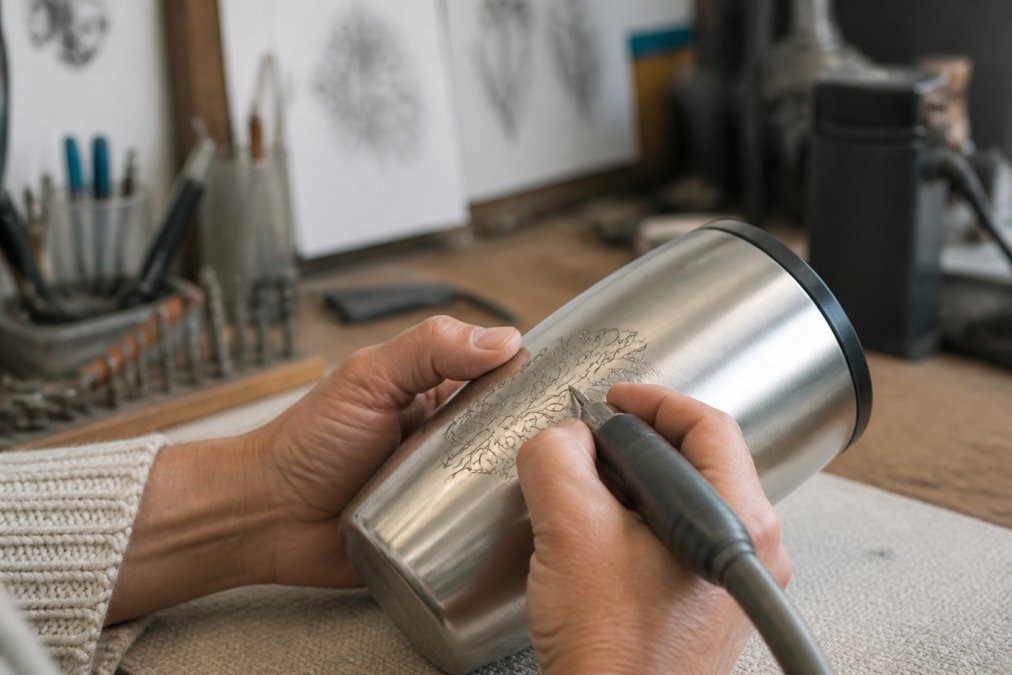
A common mistake buyers make is assuming design work is free because it happens on a screen. In practice, a skilled designer spends real time interpreting a brief, sketching concepts, revising based on feedback, and preparing production-ready files. That's labor-intensive work, and it's the same whether the order is one piece or fifty.
Then there's the production labor itself. Handcrafted work moves at human speed. Applying a full-wrap design to a curved surface, aligning artwork around a tumbler, checking color accuracy against a proof, these steps can't be rushed without visible quality loss. This is where craftsmanship earns its premium.
Specialized Equipment, Materials, and Craftsmanship in Custom Gift Production
Durable custom gifts require specialized equipment. These costs are recovered through the price of the pieces they produce.
Storybook Bear Mosaic 20 oz Stainless →
Material quality compounds the equation. Premium stainless steel, food-safe finishes, and design coatings that resist fading all cost more than commodity alternatives. A double-wall insulated tumbler holds temperature for hours because of how it's built, not because of marketing language.
What most guides miss is that the material decisions and the equipment decisions are linked. You can't apply a durable full-wrap design to a low-grade surface and expect it to last. The two have to match, and matching them costs money.
Lynne's Creations offers custom order options to ensure you receive something made just for you.
Your Personalized Gift Pricing Guide: What You're Actually Paying For
Here's the practical version. When you buy a custom gift, your money is going to five places:
- Design and proofing - Concept work, revisions, and production-ready files
- Materials - The base object plus any premium coatings or finishes
- Labor - Hand application, assembly, and finishing time
- Equipment overhead - The machines and tooling required to produce the piece
- Production overhead - Packaging, quality checks, and order handling
At Lynne's Creations, a 20 oz stainless steel skinny tumbler, like the Storybook Bear Mosaic design, runs $20.00. That price reflects a double-wall insulated build, full-wrap stained-glass-inspired artwork, a matching lid, and a reusable straw. It's not the cheapest tumbler on the market. It's a specific piece made to be given, not just used.

The Stained Glass Lily tumbler sits at the same $20.00 price point with the same construction.

Supply Chain Transparency, Sustainability, and the Waste Factor
Most pricing conversations skip the two topics buyers increasingly care about: where materials come from and what happens to the waste. Both are legitimate cost drivers, and both are places where a custom maker's price reflects real choices rather than padding.
Sourcing Unique Materials Costs More Than Buying Commodity Stock
Lynne's Creations offers high-quality, tactile, and meaningful presents. Our products are crafted with care to provide a tactile and expressive touch to your home.
The Waste Factor Is Real, Here's How to Ask About It
Custom production generates more per-unit scrap than mass production. That's a fact, not a flaw. The question is what the maker does with it. Smaller studios often source in smaller batches from suppliers they can name, which reduces overproduction but doesn't eliminate offcuts. Buyers who care about sustainability should ask directly: where does the stainless steel come from, and how are misprints handled?
Post-Purchase Support Is a Cost, Not a Courtesy
This is the gap almost every competitor misses. A custom gift isn't finished when it ships. It carries a service tail that mass-market products don't.
Conclusion: Making an Informed Choice for Meaningful Gifting
The premium on custom gifts isn't arbitrary. It reflects design expertise, hand labor, specialized equipment, quality materials, and the reality that one-of-a-kind production carries more waste and overhead than volume manufacturing. Understanding those costs turns a price tag into a decision you can defend.
Frequently Asked Questions
How much do personalized gifts typically cost?
Personalized gift pricing varies widely based on materials, complexity, and labor. At Lynne's Creations, custom 20 oz stainless steel tumblers start at $20.00. The final cost reflects the design expertise, specialized equipment, and time required for a one-of-a-kind piece. This is often higher than mass-produced items because each gift is made individually, not on an assembly line.
Why are handcrafted items more expensive than mass-produced goods?
Handcrafted items involve labor-intensive processes like design, material sourcing, and individual production, which mass production avoids through automation. For example, a custom tumbler requires a maker to create a unique design, prepare specialized equipment, and finish each piece by hand. These steps add cost but also create a product with greater craftsmanship and emotional value.
Does personalization increase the perceived value of a gift?
Yes, personalization significantly boosts perceived value. Research on the psychology of personalized gifting shows that recipients feel more connected to gifts that reflect their identity or interests. This emotional value often outweighs the monetary cost, making a $20 custom tumbler feel more meaningful than a $20 generic mug. The effort justification principle explains why recipients value gifts more when they know the giver invested time in customization.
What makes a gift feel truly special?
A gift feels special when it demonstrates thoughtfulness and personal connection. Custom gifts achieve this by incorporating the recipient's hobbies, name, or a meaningful design. For instance, a stained-glass-inspired tumbler with a storybook bear design can evoke nostalgia and show you chose something unique. The intimacy of a tailored gift often creates a stronger emotional response than a high-priced but impersonal item.