
Table of Contents
- Why Custom Glass Cutting Boards Are a Top Wedding Gift
- Personalized Wedding Kitchen Gifts: Ideas That Last
- Glass vs Wood Cutting Boards for Gifts: Which Wins?
- Our Top Custom Glass Cutting Board Designs
- How to Clean Custom Glass Cutting Boards (Without Fading the Design)
- Food Safety, Material Durability, and Print Longevity
- Small-Batch vs Bulk Customization for Wedding Parties
- Conclusion
- Frequently Asked Questions
Last Updated: September 14, 2026
Why Custom Glass Cutting Boards Are a Top Wedding Gift
Custom glass cutting boards have become one of the most requested wedding gifts because they combine everyday function with a permanent, personalized design. At Lynne's Creations, we've watched couples move away from disposable registry filler toward pieces they keep on the counter.
The appeal is simple: a custom glass cutting board is tempered glass printed with a full-color design fused into the surface rather than applied on top.

Below, we'll show you how to evaluate design, print method, and durability before you buy, plus the four designs customers order most.
Personalized Wedding Kitchen Gifts: Ideas That Last
Personalized wedding kitchen gifts work best when they survive daily use, not just the reception table. A monogrammed towel fades. A novelty mug gets pushed to the back of the cabinet. A tempered glass board keeps earning its spot.
Three categories hold up over time:
- Printed glass boards for charcuterie, cheese, and light prep work
- Engraved wood boards for heavy chopping and knife work
- Custom printed textiles like aprons and oven mitts for the couple who cooks together
The mistake most gift-givers make is choosing the item that photographs best rather than the one that gets used. Ask what the couple actually cooks: wine-night hosts need a serving surface, while Sunday meal-preppers need something that handles a knife.
Glass vs Wood Cutting Boards for Gifts: Which Wins?
Glass wins for serving and display; wood wins for heavy chopping. That resolves most of the debate, but the details matter before you commit.
| Factor | Glass Cutting Board | Wood Cutting Board |
|---|---|---|
| Best for | Serving, charcuterie, display | Chopping, knife work |
| Print durability | Sublimated into surface | Engraved or burned |
| Cleaning | Hand wash recommended | Hand wash, oil regularly |
| Design detail | Full-color, photographic | Single-tone engraving |
| Weight | Lighter for its size | Heavier, thicker |
Glass holds a photographic, full-color design wood cannot reproduce, while wood absorbs impact and is gentler on knife edges. For a wedding gift, the deciding question is whether the couple will display it or abuse it.

Most customers choose glass for display and serving and keep a separate wood board for prep.
Our Top Custom Glass Cutting Board Designs
The four designs below are the ones wedding parties order most. All are 11" x 7.87" tempered glass with a sublimated full-color print, priced at $15.00.
Farmhouse Rooster: Rustic Charm for Country Kitchens
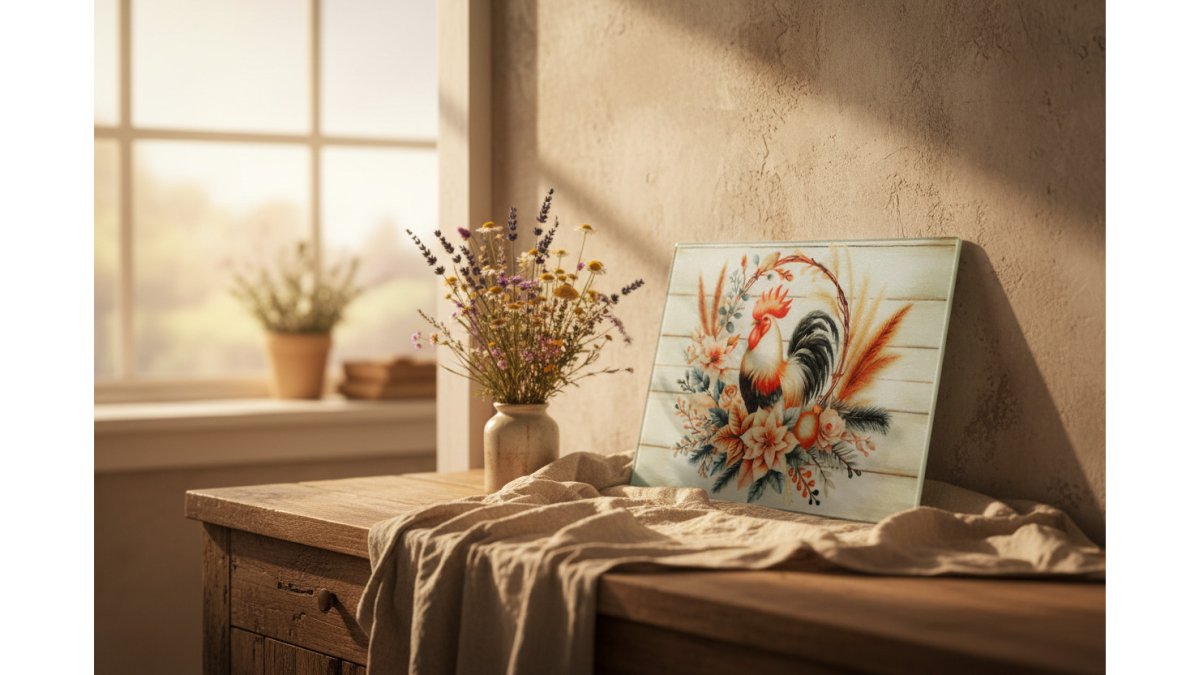
For the couple with a farmhouse kitchen, the Farmhouse Rooster Glass Cutting Board pairs a detailed rooster with a wreath of poinsettias, roses, pampas grass, and eucalyptus. It reads as decor first and kitchen tool second, and hangs well as wall art.
She's Got A Knife: Humor That Gets a Laugh
Some couples want a gift that gets a laugh at every dinner party. The "She's Got A Knife!!!" Glass Cutting Board features three wide-eyed chickens in full panic mode under the warning line.
Shark Coochie Board: The Charcuterie Conversation Starter
Nobody nails "charcuterie" on the first try, and the Shark Coochie Board leans into that. A bold sublimated great white shark sits beside the line "Because No One Can Say Char-cu-te-rie."

Kitchen Crimes In Progress: For the Drama Lovers
The "Kitchen Crimes In Progress" Glass Cutting Board shows a giant knife, screaming cucumbers, a panicked carrot, and tomatoes in full crisis mode. It fits the couple who laughs at their own chaos.
How to Clean Custom Glass Cutting Boards (Without Fading the Design)
Hand wash custom glass cutting boards in warm water with mild dish soap, then dry immediately with a soft cloth. Skip the dishwasher, abrasive scrubbers, and soaking to preserve the print for years.
Here is the routine that works:
- Wipe the surface with a soft sponge and mild soap after each use
- Rinse with warm water and dry with a microfiber cloth
- Store upright or hang to avoid surface contact with other dishes
- Avoid citrus-oil cleaners, which can dull the finish over time
- Never use steel wool or scouring pads on the printed side
A common mistake is treating a printed glass board like a plain glass one. The design is fused into the surface, not painted on, so it will not peel or flake under normal use. It will still dull if you scrape it with metal or run it through a hot dishwasher cycle repeatedly.
Food Safety, Material Durability, and Print Longevity
Most custom kitchenware listings say a product is "food safe" and stop there. That word is doing a lot of work, so it is worth unpacking what makes a printed glass board safe to serve on, how long the print survives, and which claims you can verify.
What "food safe" actually means for a glass board
A food-contact surface needs to be non-porous, non-toxic, and stable under realistic temperatures. Tempered glass clears all three: it does not absorb juices, odors, or bacteria the way a scored wood board can, and it does not leach into food the way some soft plastics can (the FDA).
The compliance language to look for on a listing or spec sheet:
- FDA food-contact compliance. In the U.S., food-contact materials fall under FDA oversight, and reputable suppliers can state that their glass and inks meet FDA food-contact requirements (the FDA). Ask for it in writing if it is not on the page.
- California Proposition 65. This state law requires warnings for products containing certain listed chemicals above set thresholds. A supplier that can confirm Prop 65 compliance is telling you something concrete about what is in the print.
- BPA-free and phthalate-free inks. Sublimation inks and coatings on decorated glass should be formulated without BPA or phthalates, especially on the printed face that touches food.
- Tempered, not annealed, glass. Tempered glass is heat-treated to be several times stronger than ordinary annealed glass and breaks into small, blunt fragments rather than sharp shards. If a listing just says "glass" without "tempered," ask.
How long the print actually lasts
Print longevity comes down to how the design is bonded to the glass.
- Sublimation infuses the design into a polymer coating on the glass at high temperature, so the color sits within the surface rather than on top of it. Under normal hand-washing, a sublimated print resists fading, peeling, and scratching for years.
- UV-cured printing lays ink on the surface and cures it with ultraviolet light. It can look sharp, but the ink layer sits on top and is more vulnerable to abrasion and hot-water cycles.
- Vinyl decals and applied films are stickers by another name. They lift at the edges, trap water underneath, and fail first.
If a listing does not name the method, assume the least durable option.
The dishwasher question, answered honestly
Sublimated glass boards are widely described as "dishwasher safe," but the honest answer is more nuanced. Repeated cycles expose the print to sustained heat, harsh detergents, and abrasive water jets, which over time dull color and cloud the finish even on a well-bonded print.
A practical rule most makers follow: hand wash for daily use and treat the dishwasher as an occasional convenience. If you do run it through, use a normal (not heavy or sanitize) cycle, skip the heated dry, and load it so it is not banging against other dishes.
Where glass falls short
A glass surface will dull a sharp blade quickly, so treat this as a serving board that handles light prep, not a butcher-block replacement. Keep a wood or plastic board for chopping and reserve the glass board for cheese, charcuterie, and presentation, that keeps both the print and your knives in good shape.
FDA food-contact and food-grade material guidance
Small-Batch vs Bulk Customization for Wedding Parties
Almost every custom kitchenware page is written for corporate bulk buyers ordering hundreds of logo'd items, leaving two groups badly served: the friend ordering a handful of wedding pieces, and the small creator ordering a short run to sell or gift.
Where the real breakpoints are
Order size changes how a custom job is priced and produced.
| Order size | Typical use | What changes |
|---|---|---|
| 1-5 pieces | Gifts, samples, one-off designs | Highest per-piece cost; maximum design freedom; each piece can differ |
| 6-24 pieces | Wedding parties, small favors, short runs | Per-piece cost starts to drop; a single approved design keeps the group consistent |
| 25-99 pieces | Small business runs, event giveaways | Setup and proofing costs spread across more units; design changes get expensive |
| 100+ pieces | Corporate and large events | Lowest per-piece cost; one locked design; longer lead times |
The trade-off is simple: more pieces means a lower per-piece cost but less freedom to vary the design.
The small-batch play most wedding parties miss
If you are ordering for a wedding party of eight or more, place the order as a single batch rather than eight separate orders. Batch orders keep the design consistent across every piece and simplify the proofing step, since you approve one layout instead of eight.
For small creators and small businesses
A simple decision framework
- Ordering for one couple? Go small-batch and personalize freely.
- Ordering for a wedding party? Order one design in a single batch for consistency, then add one personalized piece for the couple.
- Testing a product idea? Start small, prove the design, then scale to a bulk run once you know it sells.
- Ordering for a business or event? Move to bulk once your design is locked, and accept less flexibility in exchange for a lower per-piece cost.
| Order Type | Best For | Design Flexibility | Consistency |
|---|---|---|---|
| Small batch | Mixed designs, test orders, individual gifts | High | Varies per piece |
| Bulk | Wedding parties, favors, business runs | Single approved design | Identical across pieces |
Conclusion
Choosing a wedding gift that survives past the honeymoon takes more thought than most registry lists suggest. The couples who actually use what they receive are the ones whose gifts matched how they cook, serve, and host.
Lynne's Creations makes that choice easier with handcrafted kitchenware built for everyday display and use. Our glass cutting boards feature sublimated full-color designs that will not fade or peel, tempered glass construction for serving and light prep, and custom order options. Every piece arrives gift-ready.
Continue shopping with Lynne's Creations and find a wedding gift the couple will still be using years from now.
Frequently Asked Questions
Are glass cutting boards good for wedding gifts?
Yes, they make excellent wedding gifts because they combine practical kitchen use with decorative appeal. Custom glass cutting boards can be personalized with the couple's names, wedding date, or a meaningful design. They are durable, easy to clean, and serve as a lasting reminder of the occasion. Many couples display them as art when not in use, making them both functional and sentimental.
How do you personalize a glass cutting board for a wedding?
Personalization typically involves adding names, dates, or custom artwork through sublimation printing. You can choose from existing designs or request a custom order. For wedding gifts, popular options include the couple's monogram, a favorite recipe, or a design that reflects their shared interests. Lynne's Creations offers custom order options to help you create something unique.
Are custom glass cutting boards dishwasher safe?
Most custom glass cutting boards, including those from Lynne's Creations, recommend hand washing to preserve the sublimated design. While the tempered glass itself is durable, high heat and harsh detergents in dishwashers can gradually fade or damage the printed artwork. For best results, wash with warm water and mild soap, then dry immediately.
What are the benefits of using glass cutting boards in the kitchen?
Glass cutting boards are non-porous, which means they don't absorb odors, stains, or bacteria like wood can. They are easy to clean, resistant to scratches from knives, and can double as serving platters for cheese, charcuterie, or appetizers. Their smooth surface also makes them ideal for printing vibrant, permanent designs that won't peel or fade with proper care.
How do you choose a durable custom cutting board for daily use?
Look for tempered glass, which is stronger and more heat-resistant than standard glass. Check that the design is sublimated or permanently infused rather than a surface decal that can peel. Also verify the size fits your kitchen storage and intended use. A board around 11 by 8 inches works well for most everyday tasks and serving.