
Table of Contents
- Handcrafted Kitchenware vs Mass Produced Goods: A Quick Comparison
- Quality of Materials and Manufacturing Process
- Durability and Longevity: Which Lasts Longer?
- How to Identify Handmade Ceramics and Artisan-Made Kitchenware
- Caring for Artisan Kitchen Tools
- Benefits of Artisan Kitchenware: Cost, Sustainability, and Everyday Joy
- Repairability and Supply Chain Transparency
- Conclusion: Choosing Kitchenware That Lasts
- Frequently Asked Questions
Last Updated: October 4, 2026
Handcrafted Kitchenware vs Mass Produced Goods: A Quick Comparison
Walk through any big-box store and you'll see hundreds of identical cutting boards stacked to the ceiling. Then visit a small studio like Lynne's Creations, where a single glass cutting board carries artwork you won't find anywhere else. That contrast sits at the heart of the handcrafted kitchenware vs mass produced goods debate, and it comes down to more than sentiment: the differences show up in materials, durability, repairability, and what you actually pay over the life of the piece.

Side-by-Side Comparison Table
| Factor | Handcrafted Kitchenware | Mass Produced Goods |
|---|---|---|
| Production scale | Small-batch, one piece at a time | High-volume, automated lines |
| Materials | Selected per piece, often premium | Standardized, cost-optimized |
| Design | Unique, artist-driven | Repeated across thousands of units |
| Durability | Built to be repaired and kept | Built to be replaced |
| Environmental impact | Lower volume, less waste per piece | Higher output, more packaging waste |
| Price | Higher upfront, better long-term value | Lower upfront, recurring cost |
| Best for | Gifting, heirloom use, everyday joy | Temporary or high-turnover needs |
The table tells the short version. The longer story is what happens after you bring each piece home.
Quality of Materials and Manufacturing Process
Material choice separates artisan work from assembly-line output more than any other factor. A mass manufacturer selects materials that hit a price target across millions of units; an artisan selects materials that hold up under daily use and look good doing it.
How Mass Manufacturing Works
Mass production relies on standardized molds, automated presses, and consistent inputs, so every unit leaves the line identical. The trade-off is that nothing gets individual attention: a flaw in one batch repeats across thousands of pieces, and cost-cutting often means thinner materials or printed finishes that wear faster.
How Artisan Production Works
Artisan production is slower by design. A maker pours, shapes, fires, or prints each piece individually, checking it by hand before it ships, this is where terms like hand-forged, hand-poured, and small-batch come from.
Durability and Longevity: Which Lasts Longer?
Durability favors handcrafted kitchenware in most categories, because artisan makers build for repair and long use rather than replacement cycles.
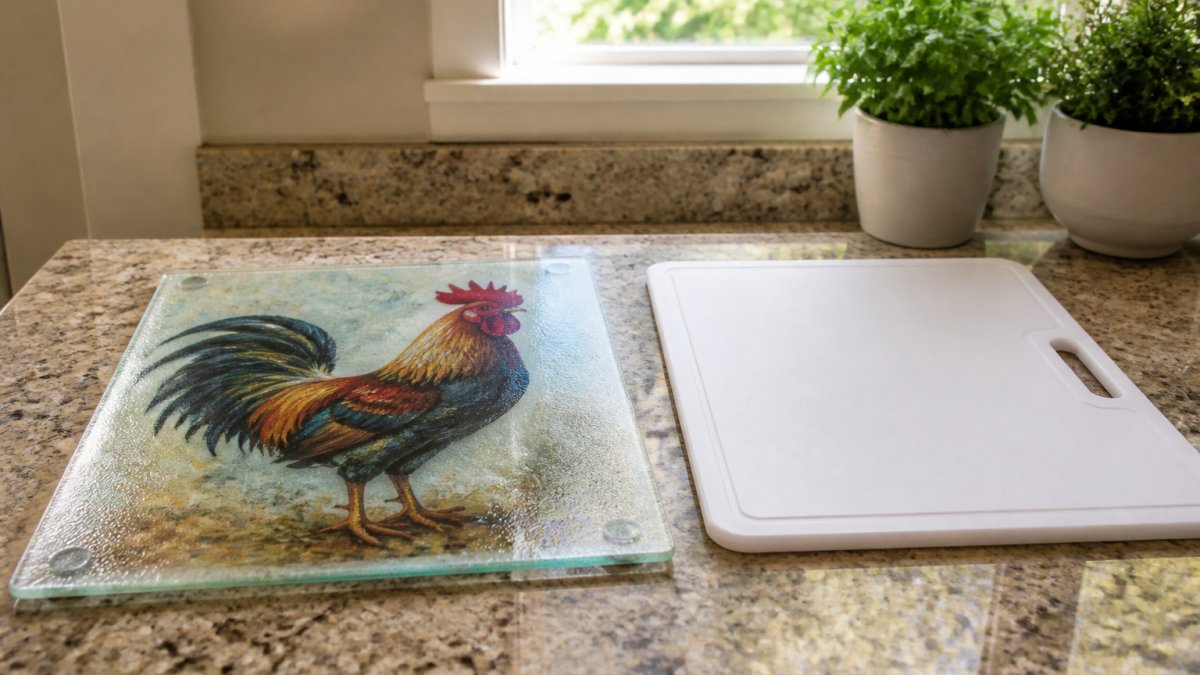
Consider a tempered glass cutting board: the material resists scratching and staining, and a sublimated design is fused into the surface rather than painted on top, so the artwork won't peel or fade with normal use.
The pattern repeats across categories. Hand-thrown ceramics chip less than thin commercial stoneware. Hand-forged knives hold an edge longer than stamped blades. The upfront cost is higher, but the replacement cycle is longer, sometimes by decades.
How to Identify Handmade Ceramics and Artisan-Made Kitchenware
Learning how to identify handmade ceramics comes down to looking for imperfection, not hiding from it. Machine-made pieces are uniform to the millimeter. Handmade pieces carry small variations in weight, glaze pooling, and surface texture that no assembly line produces.
Here's what to check before you buy:
- Weight and balance: Handmade pieces often feel slightly heavier or more balanced in the hand.
- Surface texture: Look for subtle tool marks, glaze drips, or a slightly uneven rim.
- Maker's mark: Many artisans sign or stamp the bottom of their work.
Caring for Artisan Kitchen Tools
Caring for artisan kitchen tools is simpler than most people expect: gentle washing, careful drying, and avoiding sudden temperature swings.
For glass cutting boards with a sublimated design, hand wash and skip abrasive scrubbers to preserve the print. For ceramics, let the piece reach room temperature before it hits hot water to avoid thermal shock.

A short care routine extends a piece's life by years, the quiet payoff of buying something made to last.
Benefits of Artisan Kitchenware: Cost, Sustainability, and Everyday Joy
The benefits of artisan kitchenware stretch past aesthetics into real financial and environmental territory. Yes, the sticker price is higher, but the honest comparison is not the price tag, it's the cost per use, calculated over the years you actually own each item. Most comparison articles stop at the sticker; this section runs the math.
Lifecycle Cost Analysis: The Cost-Per-Use Framework
Cost per use is simple arithmetic: total purchase and maintenance cost divided by the number of uses before the item is retired. It matters because the two production models fail on completely different timelines, and the gap compounds.
Here is the framework, applied to a cutting board, the single most-replaced item in most kitchens:
| Variable | Handcrafted Board | Mass-Produced Board |
|---|---|---|
| Upfront price | Higher | Lower |
| Expected service life | Long (often a decade or more with care) | Short (often one to three years of daily use) |
| Replacement purchases over 10 years | Typically zero | Typically several |
| Maintenance cost | Occasional food-safe oil or gentle hand washing | None, the item is discarded instead |
| Design durability | Fused or sublimated, will not peel | Printed or laminated, wears off first |
| Resale or gifting value | Retains appeal, often passed on | Effectively zero |
| Cost per use | Falls every year you keep it | Stays flat, then resets with each replacement |
The mechanism is straightforward: a mass-produced board's cost per use never improves, because you keep buying the same board again, while a handcrafted board's cost per use declines every year it survives.
Three variables drive the outcome, so you can run the math on any item:
- Service life. The longer the item lasts, the more uses absorb the upfront price.
- Replacement frequency. Every avoided replacement is a full purchase price you never pay again.
- Maintenance burden. A piece that needs occasional oiling but never replacement still beats a piece that needs nothing but gets thrown away.
Environmental Impact and Sustainability
Sustainability favors smaller production runs, and the cost-per-use framework explains why in material terms rather than sentimental ones. Mass manufacturing generates more packaging waste, more shipping volume, and, critically, more discarded product when items fail early.
Farmhouse Rooster Glass Cutting Board – 11x7.87" →
Artisan production also tends to use less material per finished piece, because makers work in small batches rather than optimizing for output volume. The environmental argument is not that handcrafted goods are magically green, it's that the replacement cycle is the hidden environmental cost of cheap goods, and breaking that cycle is the biggest lever a buyer controls.
Everyday Joy and the Human Element
There is a reason this section ends on joy rather than spreadsheets. The financial case is real, but the daily experience is what keeps a handcrafted piece in rotation. A board with a design fused into the surface, a mug with a visible glaze drip, a knife with a maker's mark on the tang, these are objects you notice. Mass-produced goods are designed to be invisible and forgotten; handcrafted goods are designed to be used and kept.
Repairability and Supply Chain Transparency
Repairability and supply chain transparency are the two areas where mass-produced goods fall shortest, and the two areas most comparison articles skip. Here is what happens when each type of item needs attention, and what you can realistically learn about where it came from.
Why Mass-Produced Goods Are Hard to Repair
Mass production is optimized for assembly, not disassembly. Components are often bonded, crimped, or molded together rather than fastened, so a single failure point can render the whole item unusable. Replacement parts are rarely sold separately, because the manufacturer's economics depend on selling you a new unit, not a $4 handle, and even when a part exists, your model may have been discontinued in favor of incompatible fittings.
The practical result: for most mass-produced kitchenware, the repair path is closed before you open the drawer. When the defined lifespan ends, the answer is a new purchase.
How Handcrafted Items Stay Repairable
Handcrafted kitchenware is built by a person who understands how it was assembled, which changes the repair equation entirely. Common patterns:
- Wooden tools and boards. Surface scratches and knife marks can be sanded out and re-oiled. Deep cracks can often be stabilized with food-safe glue and clamped. A warped board can sometimes be re-flattened.
- Ceramics. Chips on a rim can be smoothed with a diamond file. Cracks in non-food-contact areas can be repaired with food-safe epoxy. A broken handle on a mug is often reattachable if the break is clean.
- Hand-forged knives. A dulled or chipped edge can be re-ground. A loose handle can be re-peened or re-epoxied. A rusted blade can be restored with progressive abrasives.
The common thread is that the maker is reachable. A small studio can often tell you which finish was used, which adhesive is food-safe for that material, and whether the piece is worth repairing at all. That access is the real differentiator, not the repair itself, but that repair is even an option.
Supply Chain Transparency: What You Can Actually Trace
Traceability is where the gap between the two models is widest, and it comes down to how many hands touch the product before it reaches you.
A mass-produced item typically passes through raw material suppliers, component manufacturers, assemblers, exporters, importers, distributors, and retailers.
A small studio compresses that chain. The maker usually knows the supplier of their clay, glass, steel, or wood, who fired the kiln or ran the press, and what finish was applied and why.
A Practical Test Before You Buy
Ask one question of any kitchenware purchase: If this breaks, who do I call? If the answer is a customer service line for a brand that may not exist in five years, you are buying a disposable item. If the answer is a named maker who can explain how it was built and how to care for it, you are buying something with a repair path.
Conclusion: Choosing Kitchenware That Lasts
Every kitchen needs tools that hold up, and the choice between handcrafted kitchenware and mass-produced goods shapes how often you replace them. At Lynne's Creations, we build small-batch, gift-ready pieces designed to bring artistic beauty into everyday moments. Our handcrafted glass cutting boards, like the Farmhouse Rooster design, pair tempered glass with a permanent sublimated print that won't fade or peel.
Frequently Asked Questions
Is handcrafted kitchenware more durable than mass-produced items?
It depends on the material and construction. Handcrafted pieces often use thicker materials and are inspected individually, which can mean fewer weak points. Mass-produced items are consistent but built to a price point, so corners get cut on material thickness. A tempered glass cutting board with a sublimated design, for example, resists fading and peeling far better than a printed plastic board that wears down after months of use. The key difference is that artisan makers tend to prioritize longevity over production speed.
How can you tell if a kitchenware item is truly handcrafted?
Look for small variations between pieces, which signal manual operations rather than stamped production. Check for maker's marks, signatures, or slight irregularities in glaze or finish. Ask about the production cycle and whether the item was made in small batches. Mass-produced goods are identical, while handcrafted kitchenware carries subtle differences that reflect the human hand. Traceability matters too: a maker who can explain their process and materials is usually a genuine artisan.
Does handcrafted kitchenware require special care compared to factory-made goods?
Often, yes. Many artisan pieces need hand washing to preserve finishes, glazes, or sublimated designs. A handcrafted glass cutting board, for instance, should be hand washed to keep the print vibrant. Mass-produced items may be dishwasher safe, but that convenience often comes with lower material quality. The trade-off is simple: a few extra seconds of care keeps a handcrafted piece looking new for years, while cheap alternatives may need replacing every year or two.
Is artisan-made kitchenware worth the higher price point?
When you run a lifecycle cost analysis, the math often favors handcrafted kitchenware. A $15 handcrafted glass cutting board that lasts a decade costs about $1.50 per year. A $5 mass-produced board replaced every 18 months costs roughly $3.33 per year, plus the hassle of repurchasing. Beyond cost, artisan pieces offer unique design, sustainability benefits, and the kind of aesthetic appeal that turns everyday cooking into something you actually enjoy.
What are the environmental benefits of choosing artisan kitchenware?
Small-batch production uses less energy and generates less waste than mass manufacturing lines. Artisan makers typically source materials locally, which shortens the supply chain and reduces shipping emissions. Handcrafted items also resist disposable culture because they last longer, meaning fewer replacements end up in landfills. Choosing artisan kitchenware supports ethical consumption and keeps money in local economies rather than funneling it to large-scale factories with opaque supply chains.
The real challenge isn't finding kitchenware that looks good on day one. It's finding pieces that still look good five years in. Lynne's Creations offers handcrafted glass cutting boards with permanent sublimated designs, custom order options, and gift-ready forms built for daily use. Get started with Lynne's Creations and bring home a piece made to last.