
Table of Contents
- Why Personalized Glass Cutting Boards Make Memorable Gifts
- Custom Photo Glass Cutting Board: Uploading and Designing Your Image
- Popular Design Themes and Personalization Options
- Decorative Glass Cutting Board Display Ideas for Modern Kitchens
- How to Clean Glass Cutting Boards Without Damaging the Design
- Safety, Hygiene, and Durability: What to Expect from Tempered Glass
- Conclusion: Choosing the Right Personalized Board for Your Kitchen
- Frequently Asked Questions
Last Updated: September 20, 2026
Why Personalized Glass Cutting Boards Make Memorable Gifts
A personalized glass cutting board turns an everyday kitchen tool into something people actually keep on display. This guide from Lynne's Creations covers the design ideas, printing methods, and care steps that make a custom board last, because the difference between a board that gets used weekly and one that gets tucked in a drawer usually comes down to two choices: the design you pick and how you treat it afterward.
Most gift guides stop at "add a name and call it done." That misses the point. A board earns a spot on the counter when the design matches the person, the printing method holds up, and the material can handle real cooking. Get those three right and you have a gift that gets commented on at every dinner party.
Here is what we'll cover: the design themes that work best, display and cleaning advice, and what tempered glass actually delivers in daily use.
Custom Photo Glass Cutting Board: Uploading and Designing Your Image
A custom glass cutting board can be printed with text or artwork. The best results come from a design that leaves breathing room around the edges.

How to Prepare a High-Resolution Photo for Printing
Start with the largest file you have. Phone photos work well when they are the original file, not a screenshot or a compressed copy from a messaging app. A common mistake is uploading a picture pulled from social media, where compression has already softened the detail.
Before you upload, check three things:
- Resolution: aim for the largest file your camera or phone produced
- Lighting: bright, even light beats a dim indoor shot every time
- Cropping: leave a small margin so nothing important sits at the very edge
If you are scanning an old printed photo, scan at the highest setting available. Old family recipes, handwritten notes, and wedding photos all translate well when the source is sharp.
DIY vs. Professional Printing: What to Know Before You Order
Professional printing uses a sublimation process that fuses the design into the glass surface rather than sitting on top of it. The result does not peel, fade, or scratch off in normal use. For a gift you want to last, professional printing is the better call.
| Method | Upfront Cost | Durability | Best For |
|---|---|---|---|
| Vinyl application | Low | Moderate; edges can lift | Quick crafts, temporary decor |
| Home transfer sheet | Low | Moderate | One-off projects |
| Professional sublimation | Higher | High; design fused into glass | Gifts, keepsakes, daily use |
Popular Design Themes and Personalization Options
The strongest designs fall into two camps: sentimental and playful. Both work, but they suit different people, and picking the wrong one is the fastest way to a gift that misses. What separates a board that looks designed from one that looks printed is not the theme, it is the execution: color, type, and layout.
Monograms, Names, and Custom Text
Monograms and names suit wedding gifts, anniversaries, and housewarmings. A single initial in a clean serif font reads as elegant. A full name plus a wedding date works well for couples. Keep the text short, since crowded lettering loses impact on a small board.
For a farmhouse or cottage-style kitchen, a design like the Farmhouse Rooster Glass Cutting Board shows how artwork and warmth can carry a board without a single word of text. It works as decor first and a cutting surface second.
Humor, Hobbies, and Niche Interests
Humor boards get used more, because people enjoy reaching for them. The "She's Got A Knife!!!" Glass Cutting Board is a good example: three panicked chickens and a warning that lands every time. The Shark Coochie Board leans into the same idea for anyone who has ever stumbled over "charcuterie" at a party.

For the home cook who treats dinner as a contact sport, the "Kitchen Crimes In Progress" Glass Cutting Board captures the chaos honestly. Each of these runs $15.00 and measures 11" x 7.87", which is a practical size for both serving and display.

Color, Typography, and Layout: Design Rules That Make a Board Look Custom
Color. Glass is a cool, reflective surface, so warm tones (terracotta, mustard, cream, sage) read as inviting, while pure black and neon can look harsh under kitchen lighting. Pick a palette of two or three colors and repeat them. A board that uses one accent color against a neutral background looks intentional; a board that uses five looks like a sticker sheet. For modern kitchens, low-contrast palettes (white on cream, charcoal on gray) feel calm and high-end. For farmhouse or cottage kitchens, a single warm accent against white or wood tones fits the room.
Typography. Limit yourself to two fonts: one for the main phrase and one for supporting text like a name or date. Pair a serif with a sans-serif, or a script with a clean sans, rather than two scripts that compete. Size matters more than font choice: the main line should be large enough to read from across the room, and secondary text should be noticeably smaller. Avoid stretching or condensing a font to fit a space; pick a narrower font instead.
"She's Got A Knife!!!" Glass Cutting →
Layout. Leave a margin. Text and artwork that runs to the edge of the board looks cramped and can be clipped during printing.
Decorative Glass Cutting Board Display Ideas for Modern Kitchens
A decorative glass cutting board display works best when the board is treated as art, not clutter. Lean it against the backsplash, prop it on a small easel, or hang it near the coffee station where guests actually see it.
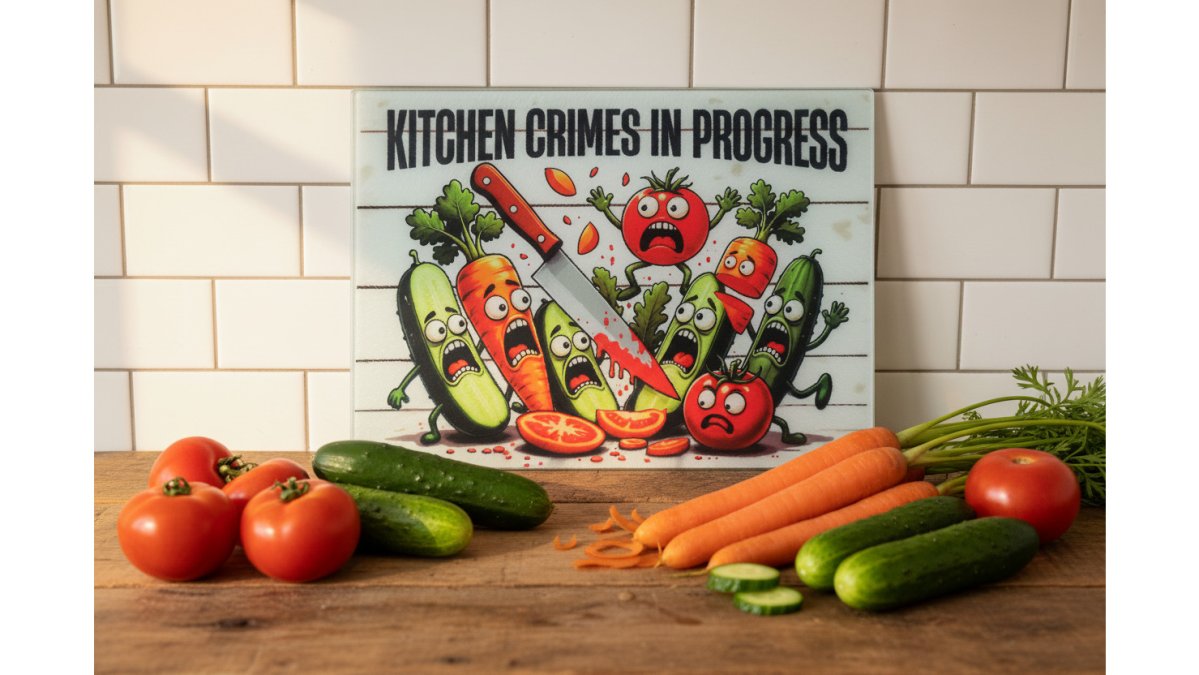
Three placements that consistently look good:
- Countertop easel: prop the board at a slight angle beside the sink or coffee maker
- Open shelving: stand it upright among cookbooks and ceramics for a layered look
- Wall grouping: hang two or three boards together as a small gallery
How to Clean Glass Cutting Boards Without Damaging the Design
Hand washing is the safest method for any printed glass board. Warm water, a soft cloth, and mild dish soap remove everyday residue without touching the design. Skip the dishwasher: high heat and harsh detergent can dull the print over time, and the manufacturer recommendation on these boards is hand wash to preserve the design. For stuck-on food, let the board soak in warm water for a few minutes, then wipe with a non-abrasive sponge.
Avoid these:
- Steel wool or scouring pads
- Abrasive powders
- Sudden temperature swings, like moving a cold board straight into hot water
Food-Safe Inks and Surface Hygiene
Professional sublimation printing uses heat to convert solid dye into gas that bonds into the glass surface, so the finished design is part of the board rather than a coating sitting on top of it. Because nothing is layered over the glass, there is no film to trap moisture, harbor bacteria, or flake into food.
Knife Marks, Scratches, and When to Retire a Board
Glass is hard on knife edges, and knives are hard on printed glass. Over time, heavy chopping can leave fine scratches across the design. Light surface scuffs usually do not affect food safety, but deep scratches that break through the print can trap residue and are a sign the board has moved past its serving life. A common pattern is to keep a glass board for serving, cheese, and light prep, and reserve a wood or plastic board for daily knife work.
Never use a glass board as a trivet for a hot pan straight off the stove. Thermal shock can crack tempered glass even though it handles everyday heat well.
Safety, Hygiene, and Durability: What to Expect from Tempered Glass
Tempered glass is heat-resistant, shatter-resistant, and non-porous, which makes it a strong choice for a kitchen surface that touches food. The non-porous surface means it does not absorb juices or odors the way some porous materials can, and it wipes clean easily.
Never use a glass board as a trivet for a hot pan straight off the stove. Thermal shock can crack tempered glass even though it handles everyday heat well.
Conclusion: Choosing the Right Personalized Board for Your Kitchen
The board that gets used is the one that fits the person, not the one with the most elaborate design. Pick a theme that matches how someone cooks, upload the sharpest photo you have, and treat the board with a quick hand wash after each use.
Frequently Asked Questions
What are the downsides of using a glass cutting board?
Glass cutting boards are harder on knife edges than wood or plastic, so they dull blades faster. They can also be slippery if not placed on a stable surface. However, tempered glass boards are shatter-resistant, easy to clean, and won't harbor bacteria like some porous materials. For everyday chopping, many people use glass boards for serving or light cutting, and reserve wood for heavy knife work. Hand washing is recommended to preserve printed designs.
How do you personalize a glass cutting board?
Personalization usually involves adding custom text or a monogram, or choosing a design theme. The design is printed using sublimation, which infuses it into the glass for a permanent, fade-resistant finish.
How do you display a decorative glass cutting board?
You can display a decorative glass cutting board on a countertop easel, prop it against a backsplash, hang it on a wall with a plate hanger, or lean it on a shelf. Group it with other kitchen decor like canisters or a fruit bowl for a cohesive look. In modern kitchens, a board with a bold design can act as a focal point. Rotate boards seasonally to keep the space fresh.
Can you put photos on a glass cutting board?
The printing process, such as sublimation, permanently bonds the design to the glass so it won't peel or fade with normal use. Hand wash only to protect the print.